A shop buys a machine-monitoring package. The business case is sound, the vendor demo goes…
MANTEC: Strengthening South Central Pennsylvania Manufacturing
Robot orders are accelerating across North America, and the buying frenzy is no longer limited to automotive giants. According to the Association for Advancing Automation, food and consumer goods orders alone jumped 105 percent year-over-year in Q3 2025, while general industry continues to outpace traditional sectors in unit volume. For South Central Pennsylvania manufacturers — many of whom serve exactly these end markets — the temptation to follow the herd is real.
The trouble is that buying a robot rarely improves productivity on its own. Industry surveys consistently show that roughly one-third of automation projects fail to meet expectations, and the failure modes are remarkably consistent: the wrong process was automated, the wrong robot was selected, the workforce was unprepared, or the underlying operation was too unstable to benefit from automation in the first place. None of these problems are visible in a vendor demonstration.
The Process Comes Before the Robot
The single most expensive mistake in industrial automation is automating a broken process. If a manual operation produces inconsistent output, has unclear standards, or runs differently across shifts, a robot will simply produce defects faster — or sit idle while operators troubleshoot. Federal research published through the U.S. Bureau of Labor Statistics on advanced manufacturing technologies confirms that cost savings and quality improvements from automation depend on process stability and workforce preparation — not on the robot itself.
Before considering any equipment purchase, manufacturers need to know exactly what the process does today: cycle time, defect rate, downtime causes, labor hours per unit, and the actual cost of poor quality. Without this baseline, return-on-investment calculations are guesses dressed up in spreadsheets. Manufacturers exploring Manufacturing Automation in 2026: The Question Every Pennsylvania Leader Is Asking gain broader context on why disciplined evaluation has become a competitive differentiator in 2026.
Match the Technology to the Application
Not every problem deserves a robot. Some operations benefit far more from fixed automation, conveyor improvements, vision systems, or simple poka-yoke devices that cost a fraction of a robotic cell. Even within robotics, the choice between an industrial robot, a collaborative robot, and a mobile platform changes the project economics dramatically. Collaborative robots represented roughly 19.6 percent of 2025 North American robot orders and continue to grow in small-batch applications, but they are not always the right answer — they trade speed for flexibility and safety.
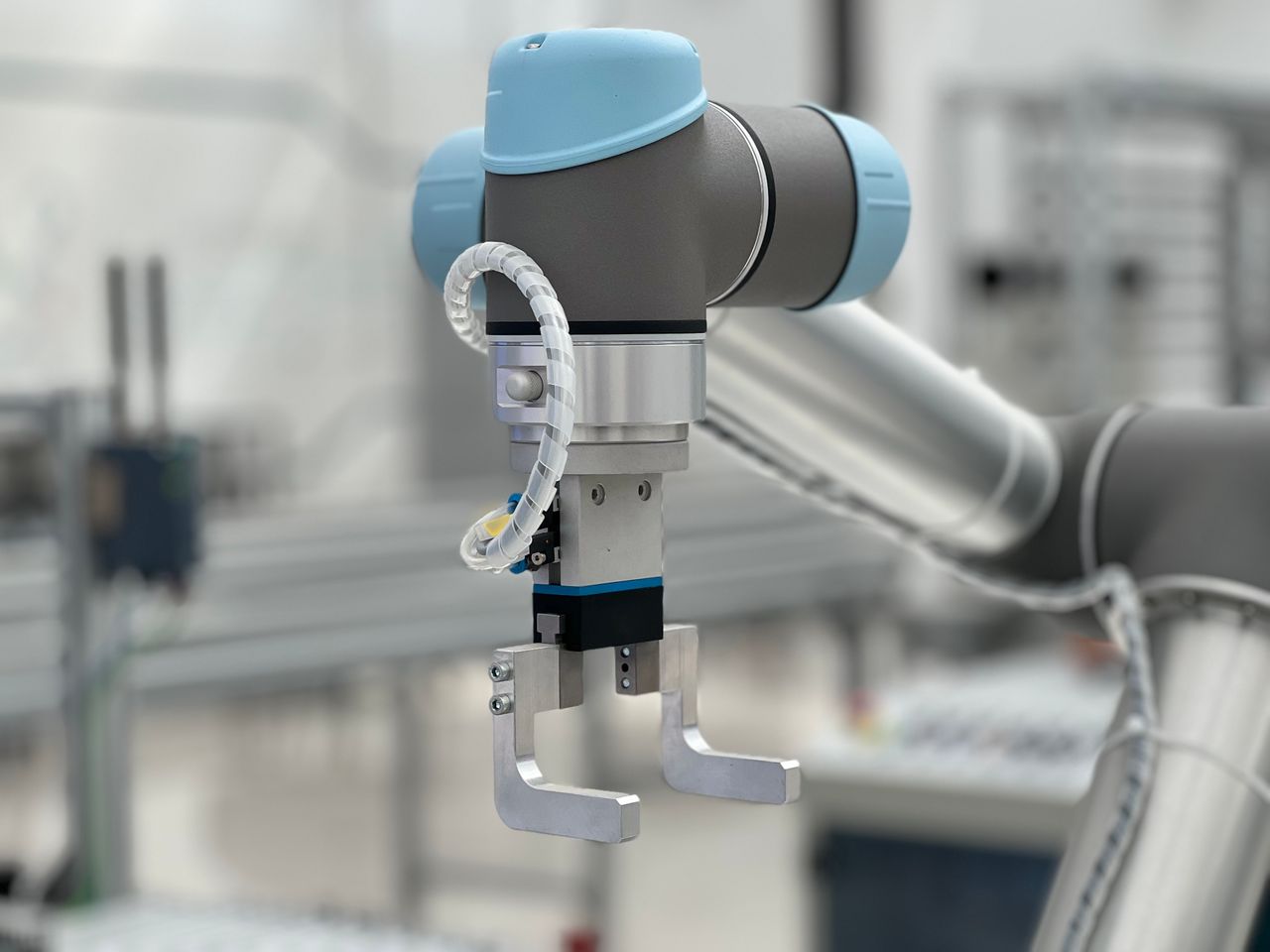
Application fit also depends on part variability, payload, cycle time targets, and the physical realities of the shop floor. A robot that performs flawlessly in a vendor demo may struggle with the dust, vibration, or tool changeovers typical of real production. This is why the National Institute of Standards and Technology’s research on emerging robotics technologies for small and medium manufacturers explicitly identifies “technical competences” — calibration, integration, sensors, end-of-arm tooling — as the dominant barrier to successful adoption, not equipment cost.
Calculate ROI Honestly
The robot is rarely the largest line item in an automation project. Integration, fixturing, end-effectors, safety guarding, programming, training, and validation often equal or exceed the equipment cost. Ongoing maintenance, software updates, spare parts, and operator retraining add 10 to 15 percent of initial investment annually for the life of the system.
Honest ROI calculations include all of this — and compare it against the documented cost of the current process, not against optimistic projections of future labor savings. When labor displacement is the entire business case, the project is fragile. When the business case combines labor productivity, quality improvement, throughput gains, and capacity expansion, it tends to survive contact with reality.
Prepare the Workforce First
Industry surveys consistently identify workforce skill gaps — not capital cost — as the leading barrier to scaled automation. Nearly four in ten manufacturers report insufficient internal expertise to design, deploy, or maintain automation systems. For Pennsylvania manufacturers already facing a projected shortfall of more than 300,000 skilled trade workers by 2030, this gap is structural, not temporary.
Successful automation deployments begin workforce preparation months before equipment arrives. Operators need to understand the new workflow, technicians need the skills to troubleshoot, and supervisors need to know what “normal” looks like when the cell is running. Manufacturers who wait until installation to think about training routinely lose months of productivity to avoidable downtime.
Pilot, Measure, Then Scale
The most successful automation programs share a common discipline: they pilot one application, measure relentlessly, fix what does not work, and only then expand. Manufacturers preparing for this kind of staged deployment also benefit from reviewing Automation Readiness: Why Most Manufacturers Aren’t Prepared for the Robots They’re About to Buy, which lays out the operational pre-conditions that separate pilots that scale from pilots that stall.
A pilot is not a proof-of-concept owned by a vendor. It is an operational test owned by the manufacturer, with clear performance metrics, defined success criteria, and a documented plan for what happens at day 30, day 90, and day 180. Vendors sell equipment. Manufacturers own outcomes.
MANTEC: Your Partner in Manufacturing Excellence
MANTEC provides South Central Pennsylvania manufacturers with independent, vendor-neutral guidance on automation decisions. Our advisors help you separate productivity-improving investments from expensive distractions.
Our Services Include:
- Smart Manufacturing Services — Automation feasibility reviews, technology assessments, and implementation roadmaps
- Robotics in Manufacturing Consulting — Independent evaluation of robotic systems, integration approaches, and workforce readiness
Ready to Make a Better Buying Decision? Contact MANTEC to schedule an automation feasibility review before your next capital request.
Works Cited
“Assessing the Impact of New Technologies on the Labor Market.” U.S. Bureau of Labor Statistics, U.S. Department of Labor, www.bls.gov/bls/congressional-reports/assessing-the-impact-of-new-technologies-on-the-labor-market.htm. Accessed 25 May 2026.
“Performance of Emerging Technologies for Robotics.” National Institute of Standards and Technology, U.S. Department of Commerce, www.nist.gov/programs-projects/performance-emerging-technologies-robotics. Accessed 25 May 2026.
Related Articles
Related Posts