MANTEC: Accelerating Manufacturing Excellence in South Central Pennsylvania Ask a plant manager in York, Lancaster,…
What is Six Sigma Methodology?
Six Sigma is one of today’s foremost process improvement methodologies. It introduces a structured six sigma process with a set of standards for organizations to follow, with the ultimate goal of trimming operational waste and redundancy and therefore eliminating errors, defects and waste.
How did Six Sigma Methodology evolve to become one of the manufacturing industry’s most prominent process improvements? And does the methodology’s results match the hype?
MANTEC’s overview of Six Sigma implementation reviews its pros, cons, certification types and implementation within the manufacturing environment. We’re establishing the foundations so you can determine which Six Sigma certification advantages your operations best then select a partner to get you there.
Six Sigma definition and core goal
NEW CONTENT: Six Sigma is a data-driven quality improvement methodology that targets near-perfect performance defined as no more than 3.4 defects per million opportunities (DPMO). The name ‘Six Sigma’ refers to the statistical measure where six standard deviations (sigma) fit between the process mean and the nearest specification limit, producing the 3.4 DPMO threshold.
How Six Sigma eliminates defects: the 3.4 DPMO standard
NEW CONTENT: The 3.4 DPMO target is not arbitrary. It represents a statistically defined level of process control where variability has been reduced so thoroughly that defects become statistically improbable. Manufacturers who achieve this standard see dramatic reductions in rework costs, warranty claims, customer complaints, and production downtime — all backed by measurable data rather than estimates.
More Six Sigma Resources for Manufacturers
The Core Six Sigma Process Steps (DMAIC)
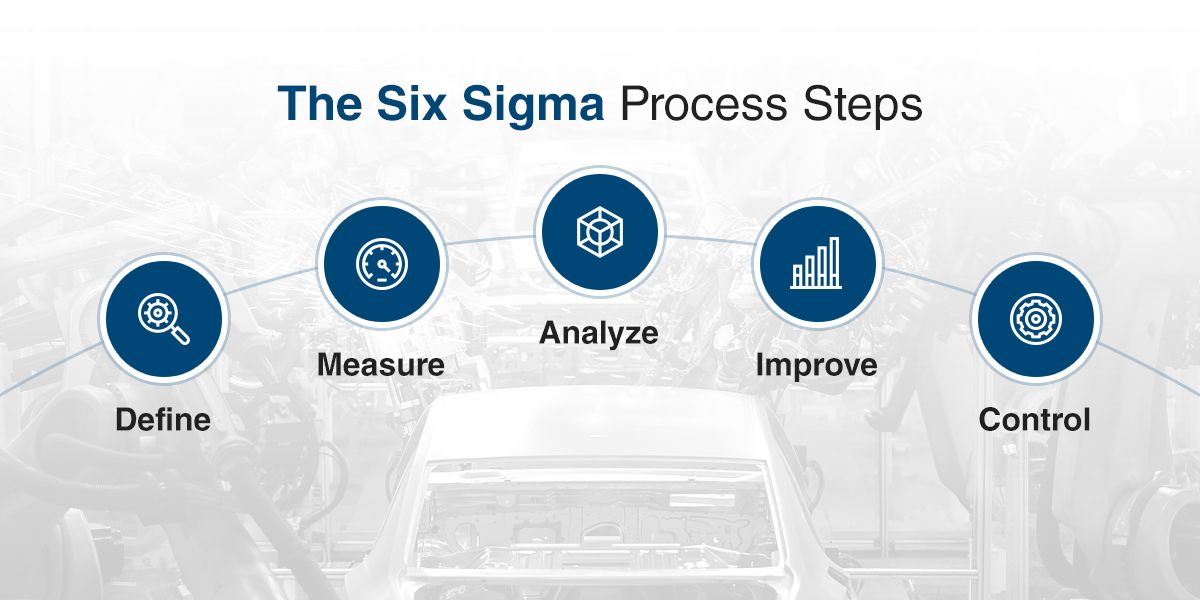
The Six Sigma Methodology comprises five data-driven stages — Define, Measure, Analyze, Improve and Control (DMAIC). This structured Six Sigma process is widely recognized as the foundation of process improvement. When fully implemented, DMAIC steps standardizes an organization’s problem-solving approach and shapes how it ideates new process solutions.
1. Define
The “Define” stage in Six Sigma methodology seeks to identify all the pertinent information necessary to break down a project, problem or process into tangible, actionable terms. It emphasizes the concrete, grounding process improvements in actual, quantifiable and qualifiable information rather than abstract goals.
Examples of terms in the Six Sigma Define phase include:
- Project scope charter, including budget, focus and driving motivation
- Voice of customer (VoC) research
- Value stream maps
- Project timeline
2. Measure
In the “Measure” phase of the Six Sigma process, organizations assess where current process capabilities are. While they understand they need to make improvements and have listed those improvements concretely in the Define phase, they cannot go about tweaking and tailoring changes until they have a data-backed baseline.
In other words, the Measure phase initiates two activities:
- Measure the current process or activity
- Use those current data sets to establish a process capability baseline, which future Six Sigma process improvement data and quality control measures will be compared against.
3. Analyze
The “Analyze” phase in the Six Sigma methodology examines the data amassed during the Measure stage to isolate the exact root causes of process inefficiencies, defects and discrepancies. In short, it extracts meaning from your data. Insights gleaned from Six Sigma analysis begin scaffolding the tangible process improvements for your team or organization to implement.Teams that pair Six Sigma analysis with a structured 8-step problem solving process can accelerate root cause resolution and move into the Improve phase faster.
Organizations can move beyond the Analyze phase of the DMAIC process once they’ve conducted the following:
- Pareto charts and similar Six-Sigma approved data maps tracking the frequency of an issue
- Potential capability (Cp) and actual capability (Cpk) calculations
- A formal root cause analysis
4. Improve
The “Improve phase” in the Six Sigma DMAIC process initiates formal action plans meant to solve the target root problems gleaned from your Analyzations. Organizations directly address what they’ve identified as problem root causes, typically deploying a Design of Experiment plan to isolate different variables and co-factors until the true obstacle is found.This stage is key to achieving measurable Six Sigma process improvement.
5. Control
In the final phase, “Control,” Six Sigma teams create a control plan and deploy your new standardized process improvements. The control plan outlines improved daily workflows, which result in critical business process variables abiding by accepted quality control variances.
Each of these five phases of Six Sigma methodology creates a repeatable template to improve your business’ process capabilities. When the five stages are fully implemented, organizations can measure both the effectiveness and efficiency of critical manufacturing business processes. Measurements are tracked in a Six Sigma control chart, lending you quantifiable, comparable process-control data that leverage a competitive advantage.
What Are the Benefits of the Six Sigma Process?

The Six Sigma methodology in the manufacturing industry carries numerous benefits of Six Sigma, each quantifiable and backed by charted growth.
1. Bolstered Productivity
Most manufacturing environments use a few key variables to measure productivity. From input figures and output units to times to market, cost-benefit ratios and more, there’s a long list of star players on a manufacturer’s productivity benchmark roster. Nearly every industrial and manufacturing operation these days searches for ways to improve these metrics, reducing overhead or lead times without sacrificing product quality or brand reputation.
Six Sigma benefits presents a quantifiable, actionable template to do so. Through its data measurements and analysis, organizations target bottlenecks, redundancies and error-prone processes, ultimately unlocking the advantages of Six Sigma that Goldilocks balance between producing more in less time.
2. Increased Throughput
Six Sigma’s philosophy of root cause identification and elimination is the ideal complement to a manufacturer looking to improve throughput rates.
Using precise data, you target exact production areas, from processing times or inspections to unit movement, queuing and warehousing. Further domain-specific data analyses then allow you to make additional micro tweaks and changes. No more enacting new or revised workflows via trial and error. Raw materials and complete units alike move swiftly through the production cycle, delivering measurable lean Six Sigma cost savings and improved throughput times to prove it.
3. Improved Quality
Six Sigma doesn’t replace the operations and workflows you perform. It aims to improve what you’re already doing, tweaking tactical adjustments here and there to reduce mistakes and eliminate redundancies. These are inevitable in the manufacturing industry — but not irreversible. The results are a throughput process that produces end-to-end higher quality goods more consistently, without upending your infrastructure or operations.
4. Reduced Incidents of Damage Control
Certified Six Sigma manufacturers have better visibility over their complete production cycle. With that knowledge comes decreased “fire drills,” — instances of major product or process defects. Six Sigma peels back the curtain on some of today’s most notorious causes of product damage in the manufacturing industry, from improperly calibrated equipment that mishandles components to complete changeover errors resulting in expensive — and cumbersome — production halts.
Managers and employees alike can focus on what they need to, with fewer ad-hoc emergencies occupying their time.
5. Leaner Operating Costs
An end-to-end efficient manufacturing operation is a less costly operation. End of story. This leaves more money in the pockets of your manufacturing company, reducing overhead and direct expenses alike and burgeoning your overall bottom line.
This represents one of the most impactful lean Six Sigma cost savings outcomes: maximizing efficiency while sustaining continuous improvement. By combining Lean manufacturing operations principles with Six Sigma tools, businesses achieve lasting operational and financial benefits.
Six Sigma in Manufacturing: Applications and Industry Use
Six Sigma in manufacturing has one guiding premise: eliminate variation within the product lifecycle so every production run aligns with an ideal outcome. Unlike generic process improvement frameworks, Six Sigma provides manufacturers with precise statistical tools to identify exactly where and why variation occurs then eliminate it at its source.
What makes Six Sigma especially relevant for manufacturers
Manufacturing environments are uniquely suited to Six Sigma because nearly every process produces measurable outputs: cycle times, defect rates, machine throughput, scrap percentages, dimensional tolerances. These outputs become the data inputs for the DMAIC process. Manufacturers can model current performance, set precise improvement targets, and verify gains with statistical confidence not gut feel.
The application of Six Sigma in the manufacturing industry spans four core areas:
- Product quality: Eliminating defects to achieve the 3.4 DPMO standard
- Process efficiency: Reducing cycle times and eliminating non-value-added steps
- Cost reduction: Quantifying and eliminating scrap, rework, and warranty costs
- Equipment reliability: Using Six Sigma data tools alongside TPM to reduce unplanned downtime
Industries using Six Sigma in manufacturing
Six Sigma in the manufacturing industry has been adopted across: automotive, aerospace, food and beverage, electronics, medical devices, heavy industrial equipment, and consumer goods. In South Central Pennsylvania, MANTEC has worked with manufacturers across these sectors to implement Six Sigma methodology from Yellow Belt training for shop-floor operators to full DMAIC project deployment with Black Belt-certified leaders.
Lean Six Sigma vs Six Sigma: What’s the Difference?
Lean Six Sigma combines the waste-elimination principles of Lean manufacturing with the defect-reduction statistical methodology of Six Sigma. While pure Six Sigma focuses on reducing process variation using the DMAIC framework, Lean Six Sigma adds Lean tools 5S, value stream mapping, pull systems, and kaizen events to simultaneously eliminate waste and variation.
The result is a more comprehensive operational improvement system: Lean removes waste (non-value-added steps, motion, waiting, inventory), while Six Sigma reduces the variability that causes defects. Together they accelerate improvement velocity and deliver faster, more sustainable results than either approach alone.
MANTEC offers Lean Six Sigma certification training at Yellow Belt, Green Belt, and Black Belt levels all designed specifically for South Central Pennsylvania manufacturers. Unlike generic online courses, MANTEC’s programs use real manufacturing scenarios and can be delivered on-site at your facility.
Explore MANTEC’s lean six sigma courses
The Challenges of Six Sigma
Like any Six Sigma process improvement, Six Sigma is not without its growing pains.
1. Differing Definitions and Approaches
The guiding philosophy behind Six Sigma is the five-stage DMAIC process, which assumes every detail and activity in the manufacturing environment involves quantifiable inputs and outputs. While this isn’t misguided, it presents problems with less immediately or obviously quantifiable operations. Without proper statistical training, organizations are burdened with the task of quantifying data points seemingly in the dark.
What’s more, DMAIC process is not the only approach used in Six Sigma theory. Others have fine-tuned similar but separate Lean Six Sigma methodology process improvement methodologies for manufacturers to adopt depending on operational efficiency goals.
2. Highly Statistical
Six Sigma relies on a diverse set of statistical tools to identify and validate a process’ root problem. Using the Six Sigma DMAIC process model alone, teams may conduct any of the following quantitative calculation techniques:
- Control chart creation
- Statistical process control (SPC)
- Potential capability (Cp) and actual capability (Cpk) calculations
- Hypothesis testing
- Six Sigma Process mapping
- Failure mode and effect analysis
- Value stream mapping
- VoC research
- And more
At the very least, organizations committing to Lean Six Sigma implementation will need a statistics or data analytics expert to guide, if not spearhead, these imperative toolsets.
3. Wider Organizational Disconnect
Leaders in the wider organization may not have the technical fluency needed for Six Sigma quality improvement buy-in and continued support. This leadership disconnect is also likely to spur misappropriated resources, with Six Sigma efforts not receiving proper time commitments, budgets, dedicated personnel and other resources needed to guide it to full process-control validation.
These challenges shouldn’t discourage your manufacturing company from researching Six Sigma training and certification advantages. With the proper commitment and org-wide communication supported by regular kaizen events to sustain momentum a Lean Six Sigma approach can be engrained into your manufacturing organization’s end-to-end workflows.”
Need Help Overcoming Challenges?
Six Sigma Belt Levels and Certification Types
There are three tiers of official Six Sigma certification levels. Through training, an organization progresses to the next level of certification. Movement up the accreditation pipeline signals an organization’s proven mastery of Lean Six Sigma concepts, as well as its ability to incorporate those concepts into daily workflows without reverting back to “old,” less efficient ways.
- Six Sigma Yellow Belt: The Yellow Belt is the foundational tier of Six Sigma belt levels. Yellow Belt training provides a topical overview of lean Six Sigma terms and applications, including managements’ roles, major statistical tools and typically the DMAIC model. Most importantly, the Yellow Belt Six Sigma certificate signifies an organization’s understanding of Root Cause Problem Solving, using appropriate data-gathering tools and techniques to reduce process variation.
- Six Sigma Green Belt: Six Sigma’s Green Belt is the intermediary accreditation available to manufacturing organizations. At this level, participants undergo in-depth tutorials on statistical tools and data modeling. Lean Six Sigma Green Belt-certified professionals can select, initiate and analyze the exact statistical models best fit to solve a project or problem variation, fluent in proper data collection, calculations, representation, interpretation and, ultimately, control chart implementation.
- Six Sigma Black Belt: The Black Belt is the third and final tier of Six Sigma belts. It is the methodology’s most advanced accreditation. Industry professionals holding a Lean Six Sigma Black Belt certification are considered Six Sigma project leaders or managers, independently able to implement a Six Sigma template across an end-to-end process improvement methodology.They are fluent in Six Sigma terminology, statistical tools and philosophical application and can coach and mentor team members at or below the Yellow and Green Belt levels.
Six Sigma Career Opportunities and Job Roles
Holding a Six Sigma certification opens doors to a range of manufacturing and process improvement roles. Employers across automotive, aerospace, food production, medical devices, and general manufacturing actively seek Six Sigma-certified professionals at every belt level.
Common job roles that require or prefer Six Sigma certification include:
- Quality Engineer / Quality Manager uses Six Sigma tools daily for defect analysis and process control
- Process Improvement Manager / Continuous Improvement Lead leads DMAIC projects across departments
- Manufacturing Engineer applies Six Sigma to optimize production cell performance
- Operations Manager uses Six Sigma data to drive OEE and throughput improvements
- Lean Six Sigma Black Belt leads cross-functional Six Sigma projects and coaches Green and Yellow Belts
In South Central Pennsylvania, demand for Six Sigma-certified professionals is strong across York, Lancaster, Dauphin, and Cumberland County manufacturers. MANTEC’s certification programs are structured to give working manufacturing employees the credentials employers recognize — without requiring months away from the plant.
The History of Six Sigma
Six Sigma’s origins span nearly four decades. Across those years, its guiding tenets have always been the same – through experimentation, organizations unlock new levels of profitability and success by fine-tuning streamlined, standardized and repeatable Six Sigma processes.
Those standardized processes are further complemented by robust data analysis. Systems are continually measured and analyzed to maintain efficiency and assure repetition, without old processes, activities and workflows creeping back in.
1. Which Was the First Company to Implement Six Sigma?
While variations of Six Sigma methods existed as early as the 1920s — most notably at Ford automobile plants in the 1920s and ’30s — telecommunications conglomerate Motorola was the first organization to officially create and use he Six Sigma methodology in the early 1980s. Prompted by increased rates of product defects, Motorola devised the management template as a way to implement tighter cost controls across its extensive electronics manufacturing branches.
The company also sought to investigate the standard industry assumption of the time, which accepted that reducing production budgets or cycle times would mean reducing the end quality of the product itself.
However, the success of its gamble paid off. Companies worldwide began taking note of the system, most notably General Electric (GE). In 1995, then GE CEO and business consultant Jack Welch introduced Six Sigma to the company’s quality control, manufacturing and business-management processes. This positioned GE as one of the first companies outside of Motorola to execute the Six Sigma process improvement methodology successfully into its organization, triggering further interest and adoption of this system.
2. In What Industries Is Six Sigma Most Prevalent?
Today, many Fortune 500 companies report integrating Six Sigma management methodologies into their organizations. The following manufacturing subfields, in particular, have adopted Lean Six Sigma processes over the years to successful results:
- Automotive
- Construction
- Consumer electronics
- Energy
- Food and beverage
- General consumer goods
- Heavy machinery and industrial equipment
- Mining
- Transportation
Application of Six Sigma in Manufacturing

Six Sigma in the manufacturing industry has one guiding premise — the elimination of variation within the product lifecycle, ultimately ensuring each run aligns with an ideal production outcome.
This goal has distinct relevancy for those in manufacturing, including many of the following:
- Product superiority: Eliminating production variability consistently creates field-leading goods. The official Six Sigma certification levels states a target goal of 3.4 defects per million chances. To most organizations, this seems an unfeasible and even impossible achievement — until they’ve fully implemented Six Sigma.
- Financial visibility: Six Sigma’s diligent DMAIC approach, among others, fine-tunes every role, responsibility and activity toward objective value measures, runs them through hypothesis tests and measures their outcomes. No stone is left unturned. This attention toward input experimentation gives heightened cost visibility, allowing organizations to execute keener calculations for a project or process’ financial returns.
- Customer delight: Six Sigma’s emphasis on Voice of Customer (VoC) research provides one of the best templates for organizations to understand the true wants, needs and opinions of their customer base. With that knowledge in hand, manufacturers can shape all products and processes to surpass customers’ expectations.
- Business stability: Six Sigma reduces business changeability. By using statistical data analysis to target and phase out previously problematic workflows, organizations objectively assure they are maximizing outputs using only the best, most researched and properly quantified inputs. The result is an organization achieving new levels of business fluidity and nimbleness, alongside tighter cost controls, smoother delivery and the greatest possible product quality.
Real-World Examples of Six Sigma
Countless organizations have seen success implementing Lean Six Sigma methods. Here are a few notable success stories:
- Microsoft: Six Sigma drove success at Microsoft by paving the way for improvements that benefited employees and consumers alike. Implementing Six Sigma increased back-end efficiency, which gave developers the support they needed to improve the user experience.
- Motorola: One of the first instances of Six Sigma’s use by a major corporation, Motorola implemented the strategy to improve product quality and drive revenue as a result.
- Boeing Airlines: Six Sigma empowered Boeing Airlines to fix an engine air fan problem. The company discovered manufacturing issues that caused harmful electrical problems.
- General Electric: Integrating Six Sigma into all operations helped GE pinpoint previously unnoticed defects that slowed production. GE’s updated strategy streamlined processes and reduced waste.
- Linde Group: This gas and engineering organization used Lean Six Sigma company consulting method to boost productivity and reduce production costs.
Tips for Implementing Six Sigma
Six Sigma has benefited numerous organizations, and it can benefit yours, too. MANTEC has tips to help your business make the most of Six Sigma certification implementation.
Allow Six Sigma to Influence Your Organization’s Goals Strategy
Six Sigma strategies are most effective when they permeate every aspect of your business. Team members at every level need to take the transition seriously so that it can properly take hold in the organization. Six Sigma should act as a core philosophy that focuses your organization on quality and productivity.
Establish Unity From the Top
Leadership has a crucial role in the success of your Six Sigma belts implementation. True improvements come when organizational leaders display a willingness to change. Leading by example will inspire more of your company to engage with the Six Sigma process.
Achieve Some Quick Victories
Transitions can be tough, so building momentum through success will boost team morale. Start with projects that middle management and senior leadership teams know team members feel passionate about. Accomplishing a goal that makes a noticeable difference in your team’s work lives will spread confidence.
Integrate Six Sigma Technology
Six Sigma and information technology (IT) thrive together. Your company can implement technology that simplifies and expedites critical processes like production and testing including Total Productive Maintenance systems that reduce equipment downtime and defects at the source. Plus, IT solutions can spot defects that slip through before the product reaches the end user.
Change Behaviors, Not Just Tools
Successful Six Sigma implementation requires an ideological shift. Everyone in your organization from the top down will need to change their behaviors to address problems once and for all. You’ll see your Six Sigma tools produce improvements when individuals using the tools modify their mindset.
Six Sigma Consultations and On-Site Training From MANTEC
MANTEC provides a range of Six Sigma programs for Pennsylvania manufacturers, including courses in:
- Six Sigma Yellow Belt
- Six Sigma Green Belt
- Six Sigma Black Belt
- A3 Problem Solving
- LEAN Six Sigma company consulting
Each is tailored to be targeted, affordable and effective explore our Lean Six Sigma certification training options to find the right fit for your team. We particularly specialize in small and medium-sized manufacturing operations here in Pennsylvania, working with our regional partners to introduce process improvements, proper statistical data analysis tools and reduce waste within your walls, for your products.
Frequently Asked Questions
Q: What is Six Sigma methodology?
A: Six Sigma methodology is a data-driven process improvement approach that aims to eliminate defects and reduce variation in manufacturing and business processes. It targets near-perfect performance at no more than 3.4 defects per million opportunities. The primary Six Sigma framework is DMAIC Define, Measure, Analyze, Improve, Control a five-phase structured process for identifying and eliminating root causes of process problems.
Q: What are the steps of the Six Sigma process?
A: The Six Sigma process follows five steps known as DMAIC:
- Define: identify the problem and project scope,
- Measure establish current process capability with data,
- Analyze: identify root causes of variation and defects,
- Improve implement solutions targeting verified root causes,
- Control: standardize improvements and sustain results through monitoring.
Q: What are the benefits of Six Sigma in manufacturing?
A: The key benefits of Six Sigma in manufacturing include: increased productivity, improved product quality and consistency, reduced defect rates and scrap costs, faster throughput, better financial visibility across production costs, and fewer emergency ‘fire drills’ caused by process failures. Manufacturers who fully implement Six Sigma also build a culture of data-driven continuous improvement that compounds gains over time.
Q: What is the difference between Six Sigma and Lean Six Sigma?
A: Six Sigma focuses specifically on reducing process variation and eliminating defects using statistical tools and the DMAIC framework. Lean Six Sigma combines Six Sigma’s defect-reduction methodology with Lean manufacturing’s waste-elimination tools (5S, value stream mapping, kaizen events, pull systems). Lean Six Sigma delivers both less waste and less variation simultaneously, making it a more comprehensive improvement system for most manufacturers.
Q: What are the Six Sigma belt levels?
A: Six Sigma has three main belt levels:
- Yellow Belt: (foundational overview of DMAIC, statistical tools, and root cause methods),
- Green Belt: (intermediate in-depth statistical modeling and project leadership)
- Black Belt: (advanced full Six Sigma project leadership, coaching Yellow and Green Belts, and end-to-end DMAIC implementation).
MANTEC offers all three levels for PA manufacturers.
Q: What is Six Sigma used for in manufacturing?
A: In manufacturing, Six Sigma is used to reduce defect rates, improve product consistency, cut scrap and rework costs, speed up production cycles, and increase equipment reliability. It is applied across quality control, production engineering, supply chain management, and maintenance operations. Any manufacturing process with measurable outputs can be improved using Six Sigma methodology.
Q: How do I get Six Sigma certified in Pennsylvania?
A: MANTEC offers Six Sigma Yellow Belt, Green Belt, and Black Belt certification training specifically designed for South Central Pennsylvania manufacturers. Courses are available at MANTEC’s York PA facility and can also be delivered on-site at your plant. WedNET PA state training grants of up to $2,000 per employee may be available to offset certification costs.
Do you have a project that would benefit from 6 sigma certification? Contact us to see our list of course schedules and begin your Six Sigma certification in Pennsylvania today.
Related Posts