A shop buys a machine-monitoring package. The business case is sound, the vendor demo goes…

A worker steps back to avoid a forklift. The pallet next to him shifts but doesn’t fall. Two minutes later, a guard pops loose before someone notices. None of these events makes it onto an OSHA 300 log, and that’s exactly the problem. Near miss reporting captures those silent warnings before they become recordable injuries, equipment damage, or unplanned downtime, and the manufacturers running it well are quietly gaining a production reliability edge their competitors can’t see.
For Pennsylvania manufacturers operating in plants where the state Total Recordable Case rate of 3.3 already exceeds the national average of 2.3, near miss reporting is one of the fastest-paying interventions available. However, the difference between a program that produces actionable data and one that fizzles after six months comes down to a handful of design choices, most of them already documented by federal safety agencies.
What the NIOSH Near Miss Reporting Data Reveals
A peer-reviewed NIOSH case study on workplace near miss reporting examined 167 valid reports submitted across a single multi-site company during a single quarter in 2018. To structure the analysis, researchers at the Pittsburgh Mining Research Division coded each event on a 5×5 risk matrix, the same approach safety professionals use to prioritize corrective actions. Specifically, the matrix scores each event on likelihood and consequence severity, producing a single risk classification for each report.
The distribution caught even experienced safety professionals off guard. Nineteen percent of events were rated low risk, 25 percent moderate, 30 percent high, and 26 percent critical. In other words, more than half of the “nothing happened” reports captured through near miss reporting scored at the top two risk levels, meaning a meaningful chance of serious harm if conditions had been slightly different. The NIOSH team’s broader conclusion is the takeaway plants should circle: near miss reporting, when systematically captured and analyzed, becomes a leading indicator that lets operations leaders intervene before equipment damage, injury, or downtime occurs. The implication is that this data is not a low-stakes paperwork exercise but a system for surfacing the most dangerous conditions on the floor before they produce harm.
This linkage between hazard signals and production performance forms the core argument in How Better Safety Makes Production Faster and More Reliable. Safety information is production information, and treating the two as separate systems leaves uptime on the table that near miss reporting could have protected.
OSHA’s Framework for Near Miss Reporting
OSHA publishes a free Near Miss Reporting Policy template built on a simple premise for any near miss reporting system. Workers will report what they see if reporting is easy, anonymous when needed, and never punitive. Furthermore, the template defines a near miss broadly enough to capture the events that traditionally slip through informal channels and never reach the people who could act on them.
According to OSHA’s framework, a near miss includes unsafe conditions, modified personal protective equipment, bypassed guards, minor incidents with potential for greater consequences, events where injury or property damage could have occurred but didn’t, and any situation where a safety barrier was challenged. The policy directs workers to submit a near miss reporting form as soon as possible, typically within 24 hours of the event. In addition, the template prohibits disciplinary action against good-faith reporters, with narrow exceptions for willful safety breaches and gross misconduct. As a result, the program’s design protects the worker dialogue that produces useful data instead of suppressing it. Plants that adopt this template as a starting point typically modify it to fit their reporting infrastructure, but the core near miss reporting principles remain unchanged across implementations.
Building a Near Miss Reporting System Workers Use
Successful near miss reporting programs share five characteristics, all of which align with both the NIOSH research and OSHA’s published guidance:
- Frictionless intake. A QR code at every workstation, a card-stock form near the breakroom, or a Microsoft Form on a shared tablet works well. If near miss reporting takes more than two minutes per submission, completion rates collapse and so does the data quality leadership needs.
- Non-retaliation, in writing and practice. OSHA’s template explicitly prohibits discipline for good-faith reports. As a result, a single instance of perceived punishment can kill near miss reporting participation for years across an entire shift.
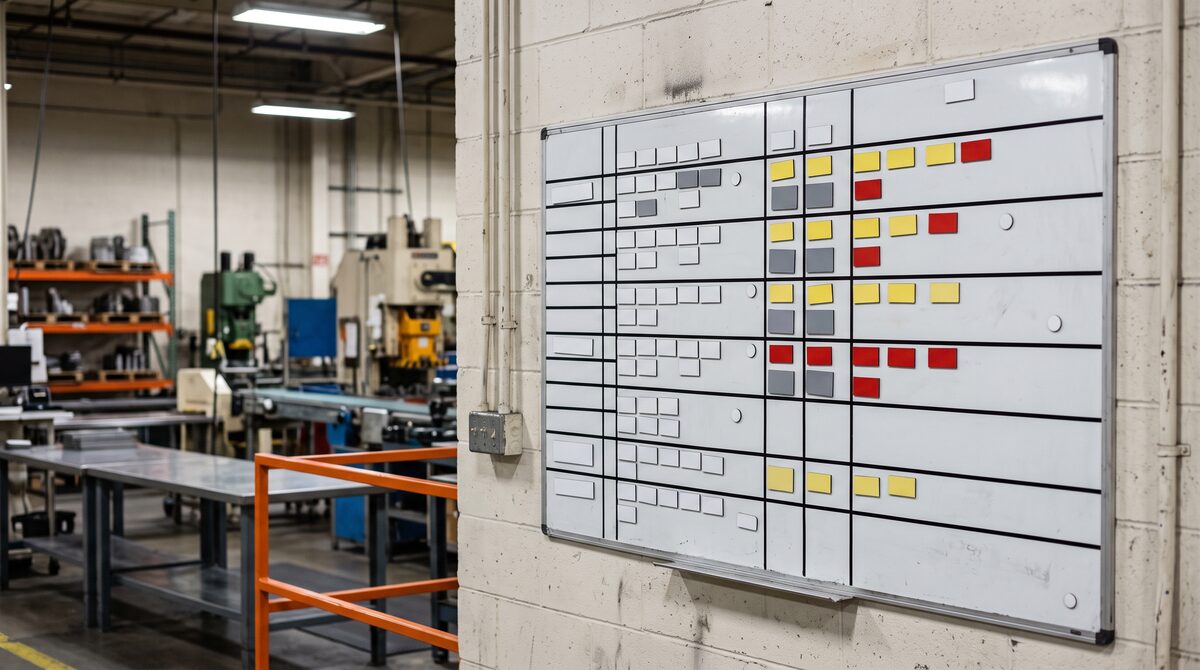
- Visible follow-through. Workers stop submitting near miss reporting forms when they sense reports go into a void. Posting corrective actions on a shop-floor board, even simple ones like “guard tightened, retraining completed,” reinforces that reports drive real change.
- Risk-based prioritization. Not every report demands a full investigation. A 5×5 matrix similar to the NIOSH approach lets supervisors triage critical near miss reporting events the same day while addressing lower-risk patterns through monthly trend reviews.
- Trend analysis. Aggregated near miss reporting data reveals which workstations, shifts, equipment, and tasks generate disproportionate risk, intelligence impossible to get any other way.
How Near Miss Reporting Drives Production Reliability
Plants that mature their near miss reporting programs typically see two outcomes within twelve months. The first is obvious. Recordable injuries drop, workers’ compensation premiums fall, and unplanned downtime tied to incident response shrinks. However, the second outcome is less obvious and more valuable in operational terms. A mature near miss reporting program produces a clearer picture of which equipment, processes, and layouts are quietly draining throughput. That picture points operations leaders to the workstations where intervention returns the most uptime per dollar invested.
For example, a near miss reporting submission about a conveyor pinch hazard often surfaces a guard misalignment. That same misalignment has likely been throwing off product flow for weeks. Similarly, a report about a chemical splash during a transfer reveals a procedural step running three minutes longer than necessary. The same conditions creating risk are usually creating waste. As a result, near miss reporting data feeds directly into the structured hazard work covered in Job Hazard Analysis and Lockout/Tagout: Why OSHA’s Top Citations Stall South Central PA Production. Together, the two programs form a closed loop between detection and prevention. That loop strengthens both safety and uptime. Manufacturers in South Central Pennsylvania stand to gain the most from this near miss reporting discipline, since mid-sized plants in the region face the steepest injury rates.
Common Near Miss Reporting Failure Modes
Manufacturers regularly trip on the same near miss reporting program pitfalls. Quotas backfire because they reward volume over quality. As a result, trivial submissions drown out the real signals leadership needs. Anonymous-only systems carry their own risk. Specifically, they can shield bad-faith reports while cutting off the worker dialogue that surfaces root causes. Furthermore, some programs route reports only to safety managers and bypass front-line supervisors. That structure fails to drive the daily behavior change that prevents incidents. As a result, near miss reporting data accumulates without producing the operational adjustments that justify the investment.
The most reliable signal of a healthy near miss reporting system is counterintuitive. Specifically, expect a steady increase in submissions paired with a steady decrease in recordable injuries. That pattern means workers trust the process. It also means hazards are being addressed before they cause harm. Many plants now treat that combination as a leading near miss reporting indicator on their operations dashboards, alongside throughput and quality metrics.
MANTEC: Your Partner in Manufacturing Excellence
MANTEC helps South Central Pennsylvania manufacturers build the operational reliability that comes from getting safety right. Our team understands the regional industry and delivers practical solutions that protect workers and production at the same time.
Our Services Include:
- OSHA 30 Certification Training — Workplace safety certification with deep coverage of hazard recognition, incident investigation, and reporting protocols
- Health & Safety Advisory Services — Safety culture assessments, hazard reduction consulting, and reporting program design
Ready to Catch Risks Before They Stop Production? Contact MANTEC to discuss how a structured near miss reporting program can strengthen your operations.
Works Cited
Haas, Emily J., et al. “Learning from Workers’ Near-miss Reports to Improve Organizational Management.” Mining, Metallurgy & Exploration, vol. 37, 2020, pp. 1015–1024. PMC, pmc.ncbi.nlm.nih.gov/articles/PMC7458492/. Accessed 29 Apr. 2026.
“Near Miss Reporting Policy.” Occupational Safety and Health Administration, U.S. Department of Labor, July 2021, www.osha.gov/sites/default/files/2021-07/Template%20for%20Near%20Miss%20Reporting%20Policy.pdf. Accessed 29 Apr. 2026.
Related Articles
Related Posts