MANTEC: Strengthening South Central Pennsylvania Manufacturing Every manufacturing operation has them: the skilled machinist promoted…

MANTEC: Strengthening South Central Pennsylvania Manufacturing
Manufacturing leaders across South Central Pennsylvania share a frustrating pattern: production numbers look fine on Monday, concerning by Wednesday, and by Friday afternoon, they’re scrambling to understand why weekly targets fell short again. The problem isn’t that teams can’t hit their numbers—it’s that delayed feedback prevents anyone from knowing there’s a problem until it’s too late to fix it.
The Bureau of Labor Statistics reports that labor productivity decreased in 52 of 86 manufacturing industries tracked in 2024, with output falling in 72 of 91 manufacturing and mining industries while hours worked actually rose in 38 industries. These numbers tell a story beyond economic headwinds: manufacturers are working harder but accomplishing less, and the visibility gap between shift-level performance and management awareness plays a significant role in this productivity decline.
For Pennsylvania manufacturers competing against larger Mid-Atlantic operations and increasingly automated facilities, the cost of delayed production feedback extends beyond missed deadlines. It means accepting quality problems that should have been caught hours earlier. It means overtime costs that could have been avoided with midweek intervention. It means supervisors who learn about issues after second shift has compounded them. The solution isn’t working harder—it’s seeing problems sooner.
The Hidden Cost of Weekly Production Reviews
Traditional manufacturing management operates on weekly rhythms: Monday planning meetings, Friday reconciliation, and everything in between left to operational inertia. This cadence made sense when data collection required manual compilation and analysis took days. Today, most manufacturers have real-time production data available—they just haven’t built the management systems to act on it.
When production problems remain invisible until week’s end, the damage compounds exponentially. A machine running slightly out of tolerance on Tuesday produces three more days of marginal parts before anyone notices. A scheduling bottleneck that develops Wednesday morning creates cascading delays that consume Friday’s capacity. The research firm QAD found that manufacturers implementing structured daily management achieved a 26% productivity boost within 90 days, primarily by catching and addressing problems that previously went undetected for days.
The visibility gap also affects workforce engagement. Frontline employees often recognize problems long before they appear in weekly reports, but without structured daily communication channels, their observations never reach decision-makers who can authorize solutions. According to recent workforce research, only 24% of frontline manufacturing workers feel adequately trained for their roles, and 40% report being unsure of job expectations—conditions that flourish when daily management conversations don’t happen.
South Central Pennsylvania manufacturers face particular pressure here. The region’s mix of precision machining, food processing, and industrial equipment production demands tight tolerances and quick response times. Companies serving automotive suppliers or meeting food safety requirements can’t afford to discover problems at week’s end when customers expect real-time quality control.
What Daily Management Actually Looks Like
Daily management isn’t about adding meetings to already packed schedules—it’s about creating structured touchpoints that make problems visible before they become crises. The most effective systems center on brief shift-start conversations where supervisors and teams review yesterday’s performance, identify today’s priorities, and surface obstacles requiring immediate attention.
These conversations happen at visual management boards displaying real-time metrics that anyone can understand at a glance. The SQCD framework—Safety, Quality, Cost, Delivery—provides a proven structure for organizing daily discussions around what matters most. When yesterday’s numbers show a quality deviation, the conversation happens that morning, not the following Monday.
The mechanics matter less than the discipline. Ten to fifteen minutes at shift start, every shift, without exception. Clear ownership of metrics, with team members tracking their own performance rather than waiting for supervisors to compile reports. Escalation paths that move unresolved problems upward quickly rather than letting them fester. Understanding the specific routines that drive improvement, as explored in The Daily Management Routine That Improves Manufacturing Productivity Every Shift, helps manufacturers implement systems that actually work rather than creating bureaucracy that burns out quickly.
The shift from weekly to daily management fundamentally changes organizational culture. Instead of finger-pointing at Friday meetings, teams solve problems Wednesday morning while solutions remain feasible. Instead of supervisors spending hours compiling reports, they spend time coaching teams and removing obstacles. The National Institute of Standards and Technology’s Manufacturing Extension Partnership network reports that since 1988, MEP Centers have helped manufacturers achieve over 152 billion dollars in new sales and 34 billion dollars in cost savings, with daily management and continuous improvement methodologies driving much of this impact.
The Supervisor Gap That Stalls Implementation
Even manufacturers who understand daily management’s value often struggle to implement it because their supervisors lack the skills to facilitate effective daily conversations. The typical manufacturing career path promotes technical experts into leadership roles without providing leadership training—creating supervisors who excel at running machines but struggle to run meetings, give feedback, or coach team performance.
This skill gap becomes painfully visible when companies attempt daily management implementations. Morning huddles become complaint sessions. Visual boards become decoration. Escalation protocols become blame chains. The problem isn’t the methodology—it’s that frontline leaders haven’t learned how to execute it. Research from PwC and the Manufacturing Institute found that nearly three-quarters of manufacturing professionals working closest to frontline leaders say positive employee experience significantly reduces turnover, but creating that experience requires leadership skills that technical training doesn’t provide.
Addressing this gap requires intentional investment in supervisor development. Companies that treat supervisor training as optional overhead inevitably discover that their continuous improvement initiatives stall at the frontline level. The leadership capabilities required for effective daily management—facilitating productive conversations, giving constructive feedback, managing conflict, coaching performance—must be deliberately built. Exploring why Supervisor Training Is the Missing Link in Your Manufacturing Production Performance reveals how targeted development programs transform technically skilled employees into effective leaders who can sustain daily management disciplines.
The good news is that supervisor development doesn’t require years of training. Focused programs covering communication fundamentals, meeting facilitation, and performance coaching can equip frontline leaders with essential skills in days rather than months. The investment pays off immediately when morning huddles become productive, escalation conversations become constructive, and daily management becomes sustainable.
Building Daily Visibility Without Overwhelming Systems
Manufacturers sometimes resist daily management because they imagine complex software implementations, expensive display systems, or elaborate reporting requirements. Effective daily management can start with whiteboards, markers, and fifteen-minute conversations. The sophistication comes from discipline, not technology.
Start with three to five metrics that matter most for each work area. Track them daily on simple visual displays visible to everyone in the area. Review them every shift start, focusing on what changed overnight and what needs attention today. Establish clear ownership—who updates which metric, who leads which conversation, who escalates which problems to whom.
The discipline of daily tracking reveals patterns that weekly summaries obscure. A machine that runs perfectly three days per week but struggles two days per week appears average in weekly reports but obviously problematic in daily data. A quality issue that correlates with specific shifts, specific operators, or specific material batches becomes visible quickly, enabling root cause investigation while memories remain fresh and conditions remain reproducible.
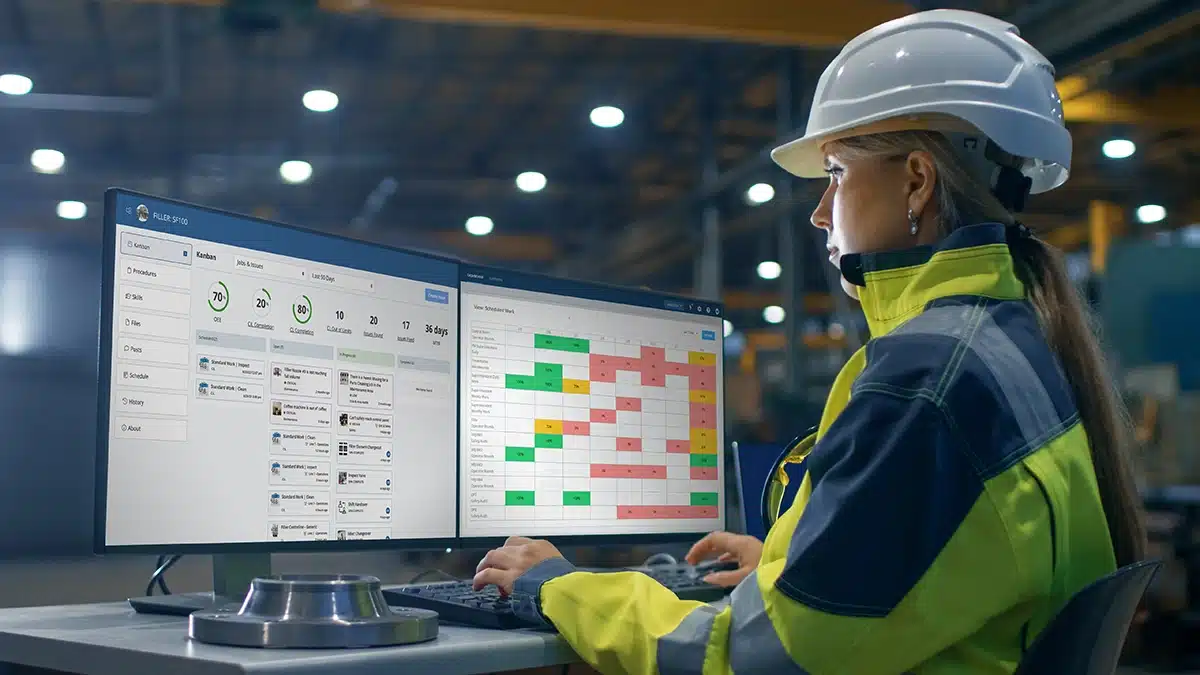
As daily management matures, technology can enhance rather than replace human systems. Digital displays can automate data collection. Mobile applications can enable real-time updates. Integrated systems can correlate production data with maintenance records, quality results, and schedule changes. But the foundation remains human: supervisors having structured conversations with their teams, every shift, about what happened, what’s happening, and what needs to happen next.
Moving from Crisis Response to Proactive Management
The ultimate goal of daily management isn’t catching problems faster—it’s preventing problems from occurring. When teams review performance daily, they don’t just identify yesterday’s failures; they spot emerging patterns that predict tomorrow’s problems. A machine showing increasing cycle time variation might run acceptably today but fail next week. Daily tracking reveals the trend while intervention remains possible.
This shift from reactive to proactive management transforms how manufacturers compete. Instead of heroic recovery efforts when shipments fall behind, teams maintain consistent flow that rarely requires extraordinary measures. Instead of quality problems that require customer notification and expedited replacements, teams catch deviations early and correct them before defective products reach packaging. Instead of supervisors spending their time fighting fires, they spend time improving processes, developing people, and strengthening the systems that prevent fires from starting.
The productivity gains from proactive management compound over time. Each prevented problem eliminates not just the direct cost of correction but the indirect costs of schedule disruption, overtime, expedited shipping, and customer relationship repair. Each successful early intervention builds team confidence and capability for catching the next issue even earlier. Manufacturing operations that sustain daily management disciplines for years develop institutional memory and operational maturity that competitors struggle to replicate.
MANTEC: Your Partner in Manufacturing Excellence
MANTEC specializes in helping South Central Pennsylvania manufacturers implement daily management systems that deliver measurable results. As a member of the MEP National Network, our team combines proven methodologies with deep understanding of regional manufacturing challenges.
Our Services Include:
- Floor Management Development System (FMDS) Training – One-day, hands-on workshops that equip frontline leaders with practical daily management tools
- Leadership Core Skills Training – Building the communication, coaching, and facilitation capabilities supervisors need to sustain daily management
- Continuous Improvement Peer Groups – Connect with other manufacturers implementing daily management to share challenges and solutions
Ready to Transform Your Operations? Contact MANTEC to discuss how daily management can help your organization catch problems early and hit production targets consistently.
Works Cited
“Productivity and Costs by Industry: Manufacturing and Mining Industries – 2024.” Bureau of Labor Statistics, U.S. Department of Labor, www.bls.gov/productivity/. Accessed 30 Jan. 2026.
“MEP Economic Impacts Boost Business and Jobs.” National Institute of Standards and Technology, U.S. Department of Commerce, 20 Mar. 2025, www.nist.gov/news-events/news/2025/03/mep-economic-impacts-boost-business-and-jobs. Accessed 30 Jan. 2026.
Related Articles
Related Posts