MANTEC: Strengthening South Central Pennsylvania Manufacturing Every manufacturing operation has them: the skilled machinist promoted…
MANTEC: Strengthening South Central Pennsylvania Manufacturing
The difference between manufacturers who consistently hit production targets and those who scramble every Friday afternoon often comes down to what happens in the first fifteen minutes of each shift. While struggling operations jump immediately into production mode—hoping yesterday’s problems won’t recur—high-performing teams start with brief, structured conversations that surface problems early, align priorities, and set the stage for productive work.
According to the Deloitte 2026 Manufacturing Industry Outlook, equipping workers with skills to maximize smart manufacturing potential ranks as the top concern for more than a third of manufacturing executives surveyed. Yet the most impactful skill isn’t technical—it’s the discipline of daily management routines that transform scattered information into actionable insight. Manufacturers implementing structured daily management report seeing an average 12-point increase in Overall Equipment Effectiveness within 90 days, equivalent to productivity gains that translate directly to bottom-line improvement.
For South Central Pennsylvania manufacturers navigating 2026’s economic uncertainty, daily management routines offer a low-cost, high-impact path to operational improvement. These systems don’t require expensive technology or lengthy implementations—they require commitment to brief daily disciplines that compound over time into transformational results.
Anatomy of an Effective Shift-Start Meeting
The cornerstone of daily management is the shift-start meeting—a brief, focused conversation that happens at the same time, in the same place, following the same format, every shift. The meeting’s power comes not from its content but from its consistency. When teams know exactly what to expect, they prepare accordingly, participate actively, and leave aligned on priorities.
Effective shift-start meetings follow a predictable structure. First, review yesterday’s results: what did we plan to achieve, what did we actually achieve, and what explains any gap? This isn’t about blame—it’s about learning. A quick scan of key metrics reveals whether the previous shift ran normally or experienced issues requiring follow-up.
Second, surface today’s priorities and potential obstacles. What’s scheduled for this shift? What resources, materials, or support might be constrained? What problems from yesterday carry forward? This forward-looking conversation prevents the reactive scrambling that wastes the first hour of production when teams discover problems they should have anticipated.
Third, identify items requiring escalation. Some problems exceed the team’s authority or capability to resolve. Daily management creates clear paths for moving these issues upward quickly rather than letting them fester. When everyone knows which problems to escalate and how, supervisors can focus attention where it matters most rather than discovering escalation-worthy issues days later.
The entire meeting takes ten to fifteen minutes—long enough to be substantive, short enough to respect production demands. Standing rather than sitting reinforces the expectation of brevity. Meeting at the production area rather than a conference room keeps conversation grounded in real work.
Visual Management Boards That Actually Get Used
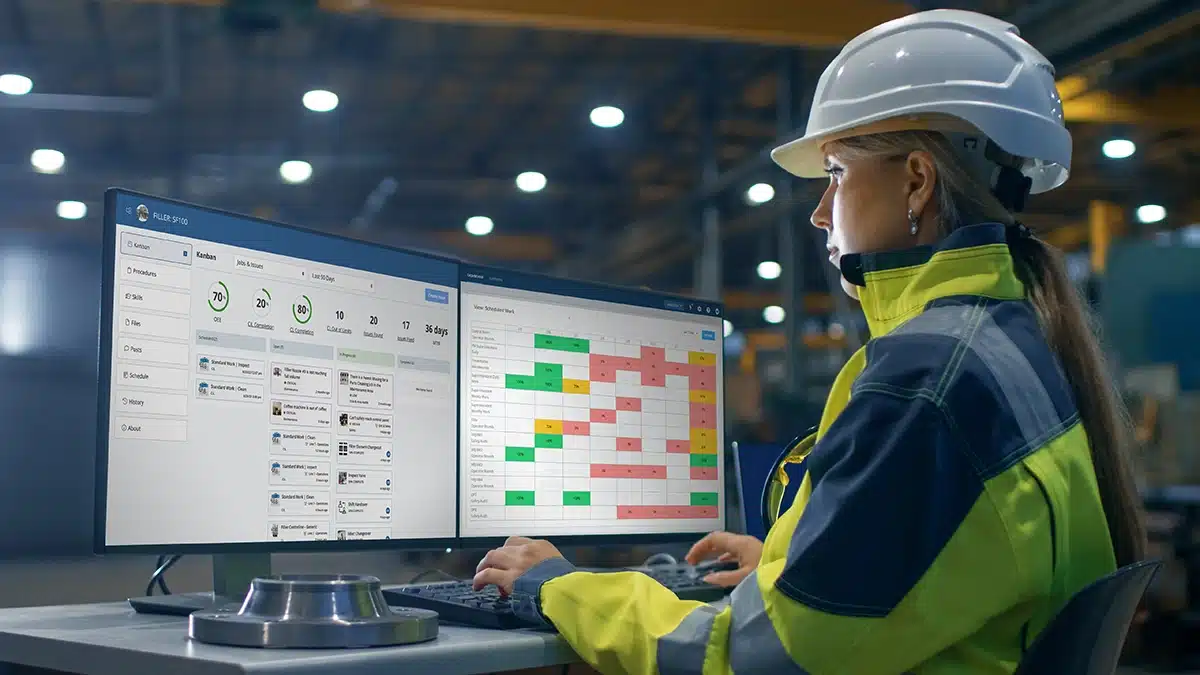
Shift-start meetings happen at visual management boards—physical or digital displays that make key performance metrics visible at a glance. These boards serve as the meeting’s agenda, the team’s scoreboard, and the operation’s memory of what’s working and what isn’t.
The SQCD framework organizes boards around metrics that matter: Safety (incidents, near-misses, observations), Quality (defects, rework, customer complaints), Cost (scrap, overtime, material variance), and Delivery (schedule adherence, on-time completion, throughput). Each area tracks three to five metrics—enough to provide meaningful visibility, few enough to enable daily discussion.
Effective boards share common characteristics. They display data visually through color coding, trend lines, and clear indicators of target versus actual performance. They’re updated consistently—ideally by team members rather than supervisors—creating ownership of the numbers and immediate awareness when performance changes. They’re positioned where teams naturally gather, making the information impossible to ignore.
The board’s design matters less than its use. Paper charts updated with markers work as well as digital displays, provided someone updates them daily and teams discuss what they show. Understanding how daily routines connect to organizational performance, as detailed in Why Manufacturers Only Discover Missed Production Targets at Week’s End—And How Daily Management Changes Everything, reveals why consistent board discipline outweighs sophisticated technology every time.
Boards also capture action items and improvement ideas that emerge from daily conversations. A simple countermeasure tracker—problem identified, owner assigned, action taken, result achieved—transforms discussion into sustained improvement. Without this tracking, good ideas disappear into the production noise; with it, each day’s insights accumulate into continuous progress.
Escalation Protocols That Move Problems Upward
Daily management creates value only when problems that teams can’t solve reach people who can solve them. This requires escalation protocols that define what to escalate, to whom, and how quickly. Without these protocols, supervisors remain unaware of problems until they become crises, and senior leaders discover issues only when customers complain.
Effective escalation follows a tiered structure. Production teams meet at shift start to review their area’s performance. Supervisors meet shortly after to review what emerged from team meetings across multiple areas. Department managers meet to review issues that supervisors couldn’t resolve. Plant leadership reviews problems requiring resources or authority beyond departmental scope.
Each tier filters information appropriately. Not every team-level concern requires management attention, but every management-worthy concern needs a clear path upward. The filtering criteria should be explicit: problems affecting safety escalate immediately regardless of other factors; quality issues affecting shipments escalate within hours; cost variances exceeding thresholds trigger supervisor review.
Escalation isn’t delegation of problems—it’s elevation of decisions. When a team identifies that a machine needs replacement rather than repair, they’re not asking supervisors to solve the problem; they’re asking for authorization to pursue the solution they’ve identified. Effective escalation protocols give teams authority to solve problems within defined boundaries while ensuring exceptions receive appropriate oversight.
The cultural shift matters as much as the structural protocols. Teams must feel safe escalating problems without fear of blame. According to McKinsey research, workers who believe they have the skills needed to work effectively tend to stay longer and be more productive—and feeling empowered to surface problems without penalty contributes significantly to that sense of capability.
Building the Habit Before Building the System
Manufacturers often make the mistake of designing elaborate daily management systems before building the basic disciplines that make any system effective. They invest in sophisticated visual displays, detailed escalation protocols, and comprehensive metrics frameworks—then wonder why teams don’t use them consistently.
Start simpler. Choose one metric that matters. Display it visibly. Discuss it at shift start. Do this every day for four weeks before adding complexity. The goal isn’t a perfect system; it’s a sustainable habit. Once daily conversation becomes automatic, adding metrics, refining boards, and improving protocols becomes natural extension rather than organizational burden.
The consistency principle applies to meeting facilitation as well. Supervisors leading their first shift-start meetings will stumble through awkward silences and tangential discussions. That’s expected. The discipline of showing up every day, at the same time, with the same structure, builds facilitation skill through repetition. Developing these leadership capabilities, as explored in Why Supervisor Training Is the Missing Link in Your Manufacturing Production Performance, accelerates the learning curve but doesn’t replace the fundamental need for consistent practice.
Resistance will emerge. Production demands will pressure teams to skip meetings. Emergencies will disrupt schedules. Some employees will question why fifteen minutes of talking improves production more than fifteen minutes of working. Leaders must protect meeting time against these pressures while demonstrating through results that the investment pays off. Once teams experience catching problems early—problems that would have consumed hours or days without daily management—skepticism typically converts to advocacy.
Sustaining Daily Management Long-Term
The most difficult aspect of daily management isn’t starting—it’s sustaining. Many manufacturers launch daily management initiatives with initial energy that fades over months. Boards go un-updated. Meetings become sporadic. Escalation protocols become optional. Within a year, the organization is back where it started, perhaps more cynical about improvement initiatives than before.
Sustainability requires leadership standard work—defined routines that ensure leaders at every level support and reinforce daily management disciplines. Supervisors attend team meetings regularly, not just when problems arise. Managers review boards and action items during gemba walks. Executives ask about daily management metrics during site visits, demonstrating organizational priority through attention.
Sustainability also requires evolution. Static systems eventually feel stale. Teams that have tracked the same five metrics for two years without modification lose engagement. Effective daily management continuously improves itself: adding metrics that prove valuable, retiring metrics that no longer drive action, refining board designs based on what works, adjusting meeting formats to address emerging needs.
Finally, sustainability requires celebrating success. When daily management prevents a problem, catches an issue early, or enables quick resolution, the organization should recognize the win. These moments reinforce the value of daily disciplines and build momentum for continued commitment.
MANTEC: Your Partner in Manufacturing Excellence
MANTEC helps South Central Pennsylvania manufacturers implement daily management systems that deliver sustained results. Our approach emphasizes practical tools and sustainable habits over elaborate systems that don’t survive contact with production reality.
Our Services Include:
- Floor Management Development System (FMDS) Training – One-day hands-on workshops covering tier boards, daily routines, and escalation protocols
- Manufacturing Matters Breakfast Series – Morning sessions exploring continuous improvement practices with plant tours and peer networking
- Total Productive Maintenance Training – Building the maintenance disciplines that support reliable daily production performance
Ready to Transform Your Operations? Contact MANTEC to discuss how daily management routines can improve productivity across your manufacturing operation.
Works Cited
“2026 Manufacturing Industry Outlook.” Deloitte Insights, Deloitte Development LLC, 24 Dec. 2025, www.deloitte.com/us/en/insights/industry/manufacturing-industrial-products/manufacturing-industry-outlook.html. Accessed 30 Jan. 2026.
“A US Productivity Unlock: Investing in Frontline Workers’ AI Skills.” McKinsey & Company, 13 Jan. 2026, www.mckinsey.com/capabilities/operations/our-insights/a-us-productivity-unlock-investing-in-frontline-workers-ai-skills. Accessed 30 Jan. 2026.
Related Articles
Related Posts